

04. February 2026, 10:24 o'Clock
Article: ABC of freight transport – S for switch
Points structure rail operations, secure routes and are a key stability factor for rail freight transport – especially in winter.
How do trains reliably reach their destination when there is a lot of parallel movement at junctions, marshalling yards and terminals? One key answer lies in the switch. It directs trains, enables routes and ensures that track systems can be used flexibly and efficiently.
Switches are among the most important operational components of rail infrastructure, but also among the most technically sophisticated. Movable tongues, precise setting and locking processes, and high mechanical loads require the exact interaction of technology, operation and maintenance. This is particularly relevant for freight transport: long, heavy trains and tight time windows leave little room for deviation.
Switches in freight transport: more than just a change of direction
In freight transport, points are much more than simple junctions. They enable shunting movements, train formation and transfers to connections with industry, ports and terminals. This means that every single point directly influences the performance of a location. If points are reliably available, routes remain flexible, parallel movements are possible and processes remain stable. Especially in heavily frequented facilities, the condition of the points determines whether operations run smoothly and predictably or come to a standstill.
Winter operation: when the switch is particularly challenged
Winter weather places additional demands on switches. Snow, ice and rapidly changing temperatures have a direct impact on tongues, control areas and frogs. As moving components, switches are particularly sensitive in this regard. To ensure functionality even in frost and snowfall, the infrastructure relies on a coordinated winter operation concept. This combines technical equipment with operational and maintenance measures. The aim is to maintain high availability of the switches even under demanding conditions.
Point heating: technical support for winter operation
An important component of this winter concept is switch heating. It is used specifically where switches are particularly relevant for operations, such as at junctions, marshalling yards or on heavily used lines. Heating prevents snow and ice from freezing in critical areas.
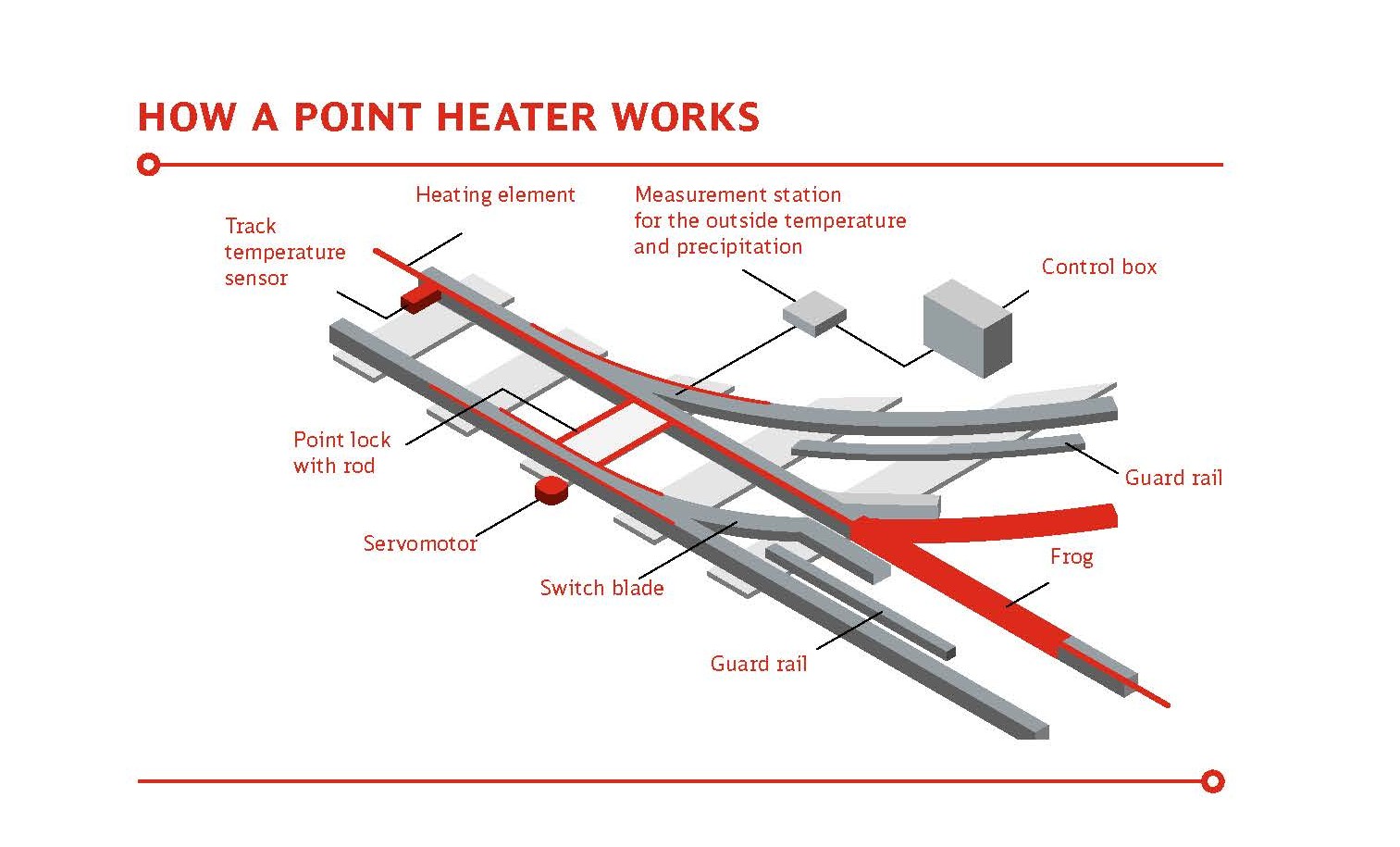
Schematic representation of a point heating system: Heating elements along the points and stock rails prevent snow and ice from freezing. Temperature and weather sensors control operation as required within the framework of the winter concept.
Modern electric switch heaters operate automatically and are weather-dependent. Sensors record temperature and precipitation, and the control system switches the heating on as required. The key principle here is that switch heating does not keep the tracks free of snow, but ensures that moving parts remain functional. Not every switch is heated. In addition, well-established maintenance processes ensure that even unheated switches can be operated reliably in winter. This creates a balanced interplay between technology and operational measures.
Benefits for operations and freight transport
For rail freight transport, a reliable switch infrastructure means above all stable processes. Signallers can set routes safely, dispatchers can rely on predictable traffic, and train drivers can trust in predictable infrastructure. The value of functional points is particularly evident in complex operational processes: they enable efficient use of track systems and support reliable transport chains – even in the cold season.
Looking to the future
With the further development of control and safety technology and the digitalisation of infrastructure, points are increasingly becoming the focus of condition-based monitoring. Setting cycles, technical parameters and operating data can be recorded and evaluated centrally. Point heating systems are also being controlled more intelligently and operated more energy-efficiently. This ensures that points remain what they are for freight transport: central, often invisible building blocks for stable and efficient rail operations.
Mikro-Glossar
Switch: Track system that directs vehicles from one track to another.
Switch blade: Movable part of the switch that determines the route.Control area: Mechanical range in which the switch is set and locked.Route: Fixed train path through switches and signals.
Point heating: Technical device for ensuring that points function in winter.

 Go
Go