
20. October 2026, 10:21 o'Clock
Article: The ABCs of freight transport: Loading dimensions – will the consignment fit on the route?
The load fits onto the freight wagon. But can the train actually travel the planned route with it? This is where the loading dimensions come into play.
When the wagon alone isn’t enough
A large machine, a long steel girder or an unusually wide component: for the shipper, the crucial question seems simple at first. Will the consignment fit on the designated wagon? For rail transport, however, this answer is not enough. This is because the wagon and its load must also pass through tunnels, fit under overhead lines and maintain sufficient clearance from signals, platforms or other infrastructure.
This is precisely where the loading gauge comes into play. It describes the boundary line which a loaded goods wagon, including its load, must not exceed under any circumstances. For transport to take place, the permissible loading gauge must be adhered to throughout the entire route.
Loading gauge explained briefly
The loading gauge defines the permissible space that a loaded goods wagon, including its load, may occupy on the route.
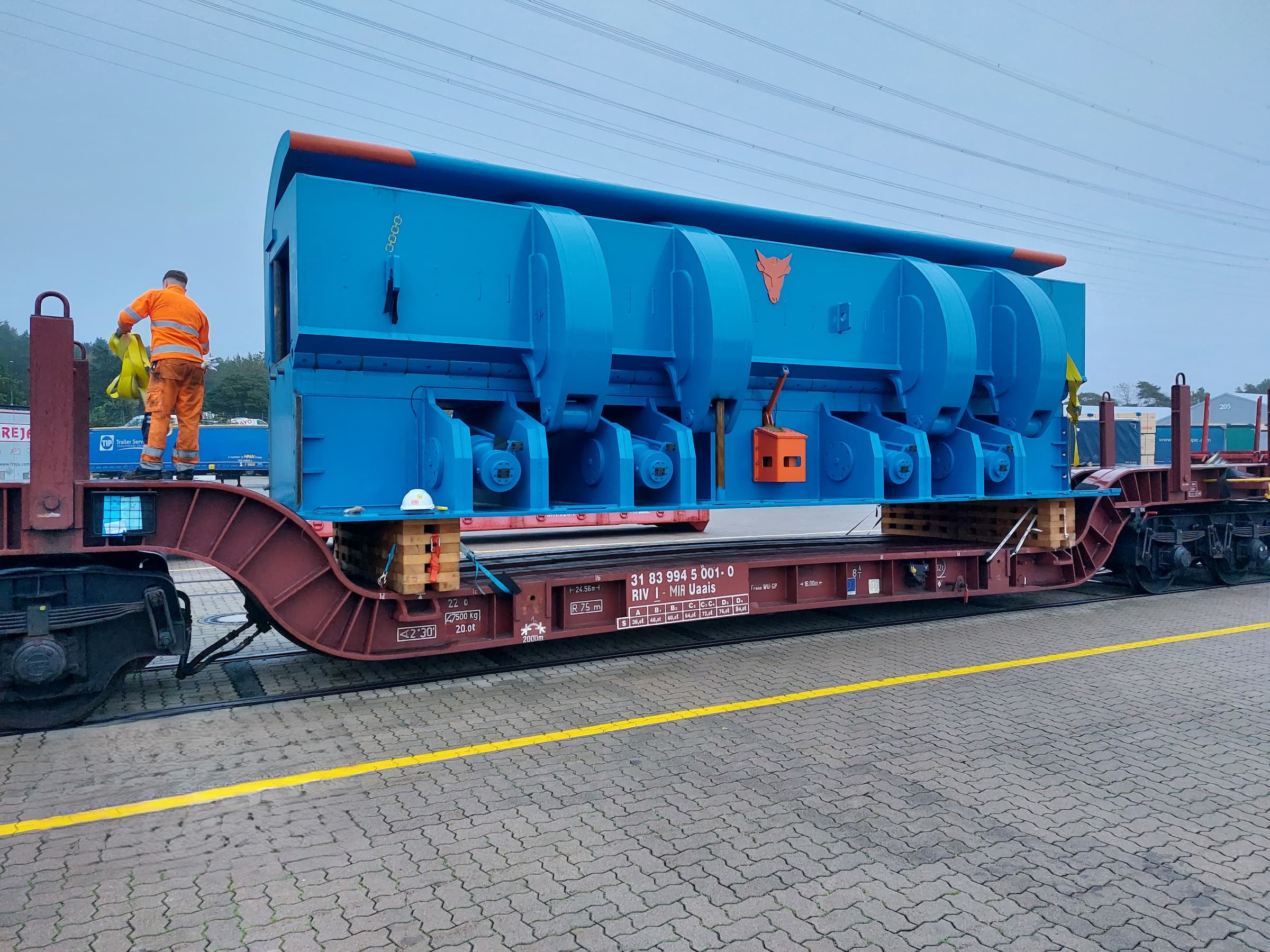
A press component weighing around 100 tonnes on a low-loader. Although the consignment remained within the load dimensions, it was transported as an oversized consignment due to its weight.
The route matters
The route also plays an important role. On curved sections of track, the lateral distances between wagons, the load and the infrastructure can change. A consignment that can be transported without any problems on a straight section of track may move closer to tunnels, signals or other installations on a curve. For this reason, in the case of large or unusually shaped consignments, checks are carried out to ensure that there is sufficient clearance along the entire route.
When do the loading dimensions become relevant?
With standard transport, the question usually does not arise at all. The situation is different for large or unusually shaped consignments. These include, for example, machinery, steel products, large components or certain vehicles.
| What matters? | |
| Machinery and industrial plant | Height, width, transport position and protrusions |
| Steel beams and sections | Length, width and possible overhangs |
| Large components and plant parts | Dimensions and navigability of the transport route |
| Vehicles | Dimensions of the loaded lorry and critical points along the route |
The sooner the dimensions are known, the sooner it can be determined which wagon and which transport route are suitable. For complex consignments, technical drawings and further details may be required.
Based on this information, DB Cargo provides support in the form of loading advice and loading calculations. This makes it possible to check at an early stage – particularly for large, heavy or unusually shaped consignments – whether transport via the intended route is feasible.

Loading consultations and loading calculations help to assess the feasibility of complex consignments at an early stage.
What information is important for the assessment
For a reliable assessment, the actual external dimensions of the consignment must be known as accurately as possible. It is not only the size of the consignment that matters, but also the position in which it is transported and whether any parts protrude beyond the wagon.
Important details include:
- Length, width and height: These indicate the space the consignment occupies on the lorry.
- Transport position: This can alter the actual dimensions, for example if a component is transported lying flat, upright or rotated.
- Protrusions: These are important if parts of the load extend beyond the vehicle or certain areas of the vehicle.
- Point of departure and destination: These form the basis for assessing the entire transport route.
- Technical drawings: These are particularly helpful for complex, large or unusually shaped consignments, enabling the dimensions and critical points to be reliably assessed.
The loading gauge considers only the external dimensions of the loaded vehicle, including its load. Weight and centre of gravity may be important for vehicle selection, load distribution and load securing, but are not included in the definition of the loading gauge.
What happens if the loading gauge is exceeded?
Exceeding the loading gauge does not automatically mean that transport by rail is ruled out. Such consignments are classified as exceptional consignments (ZS). Their suitability for transport must be assessed separately; special authorisations are required for this.
At DB Cargo, such a permit is referred to as a ‘Bza’, short for ‘Betrieb Zugförderung außergewöhnlich’ (exceptional train operation). It may, for example, specify a particular route, permit only certain tracks at stations, or exclude individual sections of track or bridges. The conditions are specified for a specific journey, including the date and train number.
Bza = Operation of exceptional train transport
The Bza sets out the conditions under which an exceptional consignment may be transported.
For international journeys, the entire route counts
In the case of cross-border transport, the load gauge check does not end at the national border. The load gauge of the German railways corresponds, amongst others, to that of the railways in Austria, Poland, the Czech Republic and Hungary. In France, Italy or Switzerland, however, the load gauges are smaller. This can play an important role in transport planning: a consignment that falls within the permissible loading dimensions in Germany may be subject to additional restrictions on a section of the route in another country. For international transport, the loading dimensions with the strictest requirements along the entire route always apply.
Load dimensions and load securing: two separate issues
Loading dimensions and load securing are linked in transport planning, but address different issues:
- Loading dimensions: Will the loaded vehicle fit on the intended route?
- Load securing: Is the load loaded and secured in such a way that it remains secure during transport?
The UIC loading guidelines, amongst others, apply to load securing. They contain internationally agreed specifications for the safe loading and securing of goods. Volume 1 describes the principles, whilst Volume 2 sets out the specific requirements for certain goods and types of load.
Conclusion
The load gauge links the load, the wagon and the infrastructure. Particularly in the case of large or unusually shaped consignments, it is therefore important to check at an early stage whether the permissible load gauge can be maintained along the entire route. On curved sections of track, there are additional restrictions on load width. If the loading gauge is exceeded, transport may still be carried out under certain conditions as an exceptional consignment. Whether a consignment fits onto the wagon is only one part of transport planning. It is equally important that the wagon, the load and the route are compatible.
Note: No personal data is collected when submitting feedback. Feedback is processed anonymously. DB Cargo Privacy Notice

 Go