
30. September 2026, 09:38 o'Clock
Article: ON A DIFFERENT TRACK - Trains stretching for kilometres, dedicated networks, long distances: What sets North America apart
The US and Canada have geared their rail freight transport towards long distances, high volumes and efficient operations.
Rail freight transport does not operate in the same way everywhere. Geography, economic structure and infrastructure all influence the role that rail plays in freight transport. This is particularly evident in North America.
The USA and Canada are among the world’s largest rail freight markets. Whilst there is frequent discussion in Europe about how to shift more traffic from road to rail, in North America rail has for decades been firmly established in the areas where it can best capitalise on its strengths: heavy goods, large volumes and long distances. The result is trains stretching for kilometres, high axle loads and transport chains, some of which extend over several thousand kilometres.
What makes North American rail freight transport so efficient, and why can many of these factors for success not simply be applied to Germany?
The USA and Canada at a glance
Longest regular freight trains: often 2 to 3 kilometres, in some cases considerably longer
USA: Around 26 to 28 per cent of freight transport is carried out by rail (approximately 2.1 to 2.2 trillion tonne-kilometres per year). *
Canada: Around 70 per cent of intercity freight is transported by rail (451 billion tonne-kilometres in 2024). *
Major freight railways: BNSF Railway, Union Pacific, CSX, Norfolk Southern, Canadian National (CN), Canadian Pacific Kansas City (CPKC)
Key feature: The infrastructure is predominantly owned by the freight railways themselves and is designed for the transport of heavy bulk goods over long distances.
* The percentages are only comparable to a limited extent, as different statistical benchmarks are used.
Sources: Federal Railroad Administration (FRA), Bureau of Transportation Statistics (BTS), Railway Association of Canada, Statistics Canada..
A continent of long distances
Geography shapes the system. In North America, the distances between major seaports, industrial centres, raw material regions and sales markets are often such that in Europe they would span several countries. Rail therefore primarily handles transport operations involving the movement of large volumes of goods over long distances. The USA illustrates these interrelationships particularly clearly: the US Department of Transportation reports a total of around 7.98 trillion tonne-kilometres of freight transport performance for 2023. Rail accounted for around a quarter of this.
At the same time, a distinctive feature emerges: rail does not carry the largest volume of goods, but primarily transports heavy goods over long distances. Of particular importance here are coal, grain, chemicals, petroleum products and intermodal container transport. Around 74 per cent of the total weight of goods transported across all modes of transport in the US in 2023 travelled a distance of less than 402 kilometres. Trucks dominate at this range of distances.
The longer the journey, the more competitive rail becomes. For journeys between 1,609 and 3,219 kilometres, rail already accounts for just under 38 per cent of transport volume.
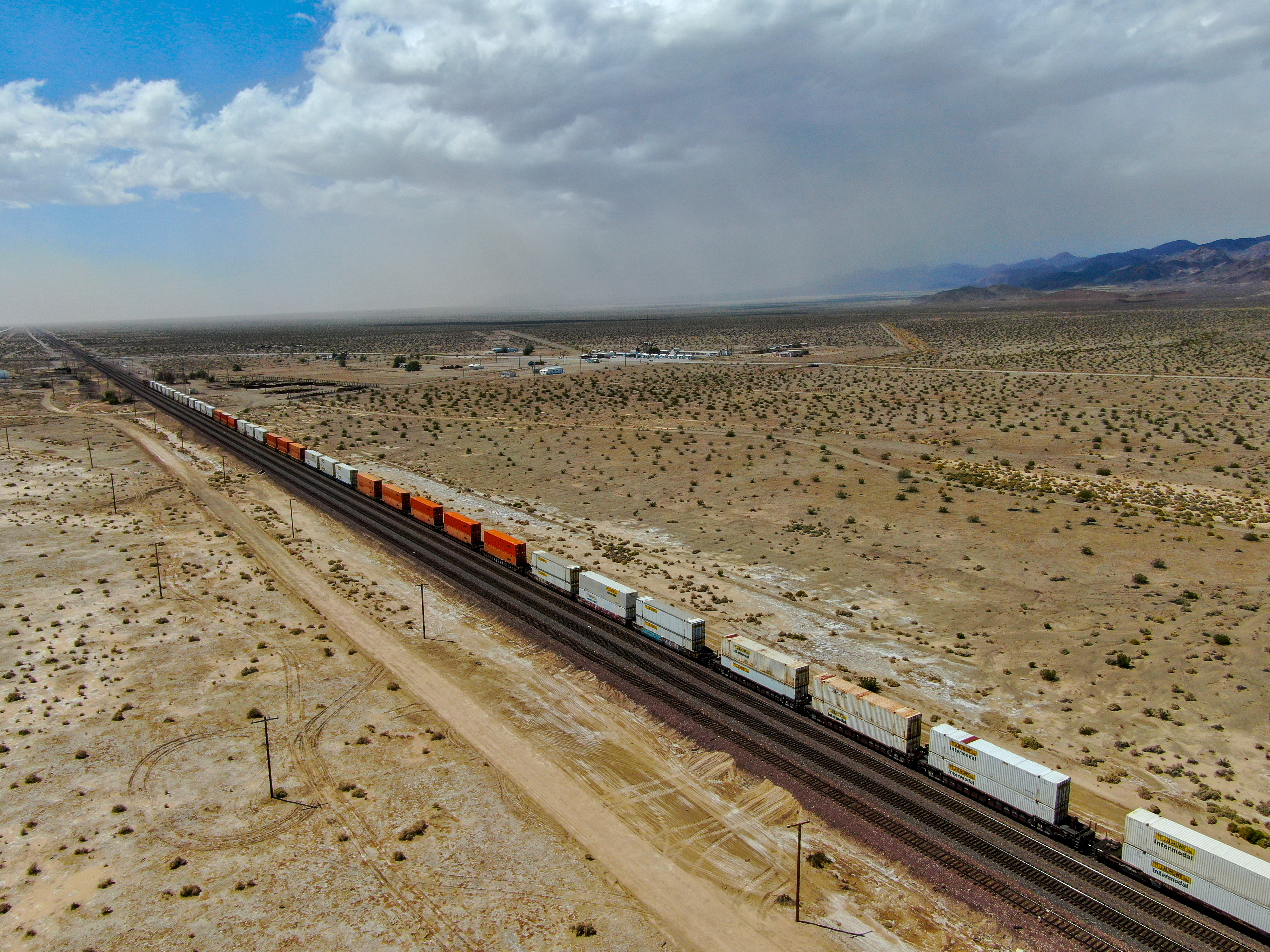
A very long freight train travelling through the wilderness of the Arizona desert in the USA.
A very long freight train travelling through the wilderness of the Arizona desert in the USA.
A railway system built for freight trains
Whilst long-distance, regional and suburban services, as well as freight trains, share the same infrastructure in Germany, the railway system in the USA and large parts of Canada was developed largely for freight transport.
Passenger trains play a comparatively minor role outside a few conurbations. As a result, there are significantly fewer conflicts over usage than on heavily utilised European mixed-traffic networks.
This is also evident from the size of the trains:
- Freight trains are often 2 to 3 kilometres long
- Train weights of 10,000 to 20,000 tonnes are not uncommon
- Axle loads of around 32.5 tonnes are commonplace
- Containers are often transported using the double-stack method, i.e. in two layers one on top of the other.
In both the USA and Canada, the infrastructure is designed to meet these requirements. Taller bridges, larger tunnel cross-sections and long passing loops create conditions that cannot easily be replicated on European networks.
Did you know: Diesel continues to dominate
In both the US and Canada, the vast majority of freight trains are powered by diesel-electric locomotives.
At first glance, this appears to be a step backwards compared with European networks. However, this is due to the enormous distances involved and the sparse population in many regions. Electrifying thousands of kilometres through mountains, deserts or remote landscapes would require substantial investment.
At the same time, industry and the authorities are working on alternative propulsion systems. These include battery and hydrogen solutions, as well as new fuels for rail transport.
The infrastructure belongs to the railways
A key difference compared with Germany lies in the ownership structure.
In the USA and Canada, the major freight railways own a large proportion of their infrastructure themselves. In the US, these include companies such as Union Pacific, BNSF Railway, CSX and Norfolk Southern; in Canada, they are primarily Canadian National (CN) and Canadian Pacific Kansas City (CPKC). They operate their lines, terminals and marshalling yards independently. The approximately 225,000 kilometres of track in the North American freight rail network are thus predominantly privately funded.
The Federal Railroad Administration reports annual investment of around 25 billion US dollars in US freight railways. Freight rail operators in the US invest, on average, around 19 per cent of their turnover in infrastructure and additional capacity.
This enables lines to be specifically designed for heavy freight trains. High axle loads, long passing sections and large terminals are an integral part of the system.
Double-stack transport – two containers stacked on top of each other
The most obvious difference compared with European freight transport is what is known as double-stack transport. This involves transporting two containers stacked on top of each other on special wagons. This significantly increases a train’s capacity without the need for additional wagons.
This is made possible by generous clearance profiles and the low level of electrification on the network. Overhead lines, which in many parts of Europe limit the maximum transport height, play only a minor role in North American freight transport.
That is why double-stack trains are standard practice, particularly in the USA and on the main Canadian freight corridors. In Germany, their use would not be possible on most routes due to tunnel clearances, bridges and overhead lines.
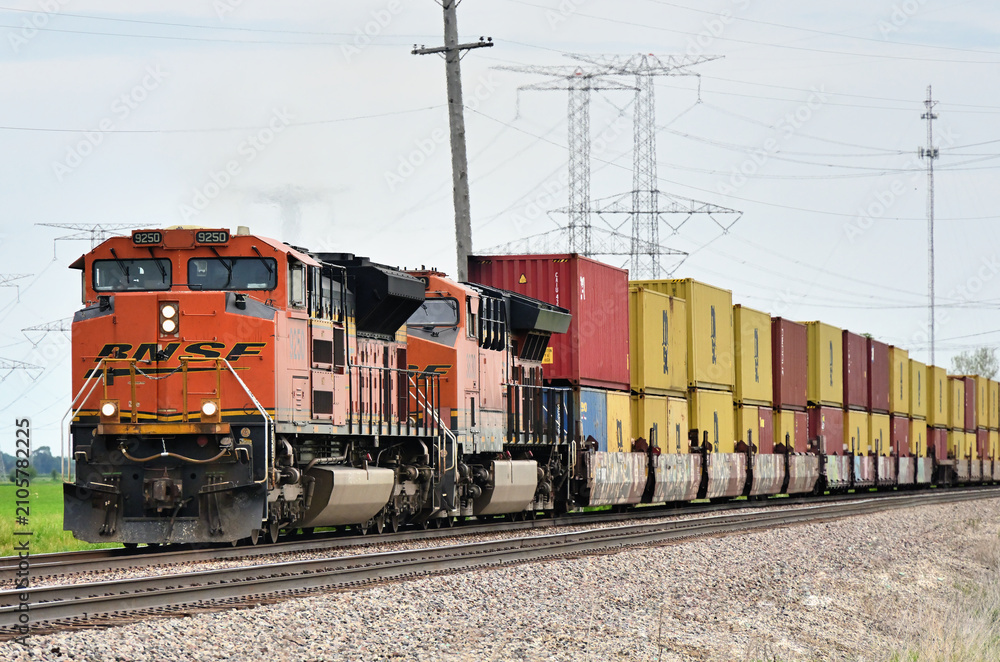
A Burlington Northern Santa Fe double-stack container train is travelling through Illinois. In what is known as double-stack transport, two containers are stacked on top of one another.
A Burlington Northern Santa Fe double-stack container train is travelling through Illinois. In what is known as double-stack transport, two containers are stacked on top of one another.
Dis you know? From Canada to Mexico without changing rail networks
Since the merger of Canadian Pacific and Kansas City Southern in 2023, CPKC has operated the first continuous rail link under a single company, stretching from Canada through the US to Mexico. If this distance were scaled to Germany, it would be enough to travel from Munich to Flensburg and back again about 16 times.
Source: CPKC
Kanada: Exportkorridore auf der Schiene
Viele der bisher beschriebenen Merkmale finden sich auch in Kanada. In einigen Bereichen ist die Ausrichtung auf lange Distanzen sogar noch ausgeprägter.
Getreide, Kali, Kohle, Eisenerz, Holz- und Papierprodukte sowie Container bestimmen große Teile des kanadischen Verkehrs. Die Bahn verbindet diese Güterströme direkt mit Häfen am Atlantik, Pazifik und den Grenzen zu den USA.
2024 erbrachten die kanadischen Bahnen rund 451 Milliarden Tonnenkilometer Verkehrsleistung. Nach 433 Milliarden Tonnenkilometern im Jahr 2020, 429 Milliarden im Jahr 2022 und 437 Milliarden im Jahr 2023 zeigt sich über längere Zeiträume kein Rückzug der Schiene, sondern ein moderates Wachstum mit zwischenzeitlichen Schwankungen.
Die durchschnittliche Transportentfernung lag 2024 bei rund 1.071 Kilometern. Das verdeutlicht die Rolle der Bahn als Rückgrat der kanadischen Exportkorridore.
Wenn Effizienz zum Leitprinzip wird
In den vergangenen Jahren hat sich der nordamerikanische Bahnmarkt verändert.
Der Rückgang der Kohletransporte verändert die Güterstruktur vieler Bahnen. Gleichzeitig gewinnt der Intermodalverkehr mit Containern und Trailern weiter an Bedeutung.
Hinzu kommt das Konzept des Precision Scheduled Railroading (PSR). Es verfolgt das Ziel, Züge stärker nach festen Fahrplänen zu betreiben, Umläufe zu beschleunigen und den Ressourceneinsatz zu optimieren.
Das Modell hat die Produktivität vieler Bahnen erhöht. Gleichzeitig wird es kritisch diskutiert. Verlader und Aufsichtsbehörden verweisen auf mögliche Auswirkungen auf Flexibilität, Personalreserven und die Reaktionsfähigkeit bei Störungen.
Was lässt sich aus Nordamerika für Deutschland ableiten?
Die USA und Kanada sind aufgrund ihrer Größe, Geografie und Wirtschaftsstruktur nicht mit Deutschland vergleichbar. Dennoch lassen sich einige Erkenntnisse ableiten:
- Klare Spezialisierung: Die Bahn konzentriert sich auf Verkehre, bei denen große Mengen über lange Entfernungen transportiert werden.
- Infrastruktur auf Produktivität ausrichten: Hohe Achslasten, lange Züge und leistungsfähige Terminals greifen ineinander.
- Direkte Verbindungen: Ganzzüge und lange Laufwege reduzieren Rangieraufwand und erhöhen die Effizienz.
- Eigene Netze: Die Infrastruktur kann gezielt an die Anforderungen des Güterverkehrs angepasst werden.
Für Verlader zeigt das nordamerikanische Beispiel vor allem eines: Die Stärke der Bahn entsteht nicht durch einzelne technische Lösungen, sondern durch ein System, das konsequent auf die Anforderungen bestimmter Güterströme ausgerichtet wurde.
Fazit: Die Stärke liegt in der Spezialisierung
Es ist nicht der kilometerlange Zug allein, der den nordamerikanischen Schienengüterverkehr prägt. Die hohe Produktivität entsteht aus dem Zusammenspiel großer Entfernungen, schwerer Güter, eigener Infrastruktur und betrieblicher Konzepte, die auf genau diese Rahmenbedingungen zugeschnitten sind.
Gleichzeitig zeigt der Blick nach Nordamerika, dass erfolgreiche Bahnsysteme sehr unterschiedlich aussehen können.
Deutschland organisiert Güter- und Personenverkehr auf einem gemeinsamen Netz. Sowohl die USA als auch Kanada haben ihre Güterbahnsysteme vor allem auf lange Distanzen und große Transportmengen ausgerichtet. Schienengüterverkehr folgt keinem universellen Modell. Er entwickelt sich aus den geografischen, wirtschaftlichen und politischen Bedingungen eines Landes. Und genau deshalb lohnt sich der Blick über die Grenzen.
Weiterführende Informationen

 Go
Go