
08. September 2026, 08:41 o'Clock
Article: ON A DIFFERENT TRACK
Rail freight through the Alps: What Switzerland does differently
Rail freight transport does not operate in the same way everywhere. Geography, infrastructure, political framework conditions and the organisation of operations all shape how goods are transported by rail. This is precisely why it is worth looking beyond one’s own national borders: other countries have developed different solutions, which also open up new perspectives on European freight transport.
Switzerland is a particularly interesting example in this regard. Around seven out of ten goods crossing the Swiss Alps are transported by rail. Behind this high share of rail transport lie decades of political decisions, massive infrastructure investment and an operational system tailored to the geographical conditions.
However, the Swiss model is not a sure-fire success. In 2025, the rail share of trans-Alpine freight transport stood at 68.6 per cent, down from 70.3 per cent the previous year. The FOT cites, amongst other things, numerous construction sites and the strained economic situation as reasons for the decline.
This makes Switzerland an interesting case study for a key question in rail freight transport: what is the point of a consistent modal shift policy if the framework conditions are changing at the same time?
Switzerland at a glance
Gotthard Base Tunnel: 57 kilometresRail’s share of trans-Alpine freight transport: 68.6 per cent (2025)Major freight rail operators: SBB Cargo and BLS CargoKey feature: The shift of transalpine freight transport from road to rail is firmly established in policy and legislation for the long term.
Sources: Federal Office of Transport (FOT), SBB Cargo, BLS Cargo.
A transit country between North and South
Its geographical location makes Switzerland a vital link between the economic regions of northern and southern Europe.Freight trains from Germany, France and the Benelux countries cross the Alps on their way to Italy and further south. Switzerland’s north-south axes are thus part of a European transport network.
The shift of freight transport from road to rail has been a political priority in Switzerland for decades. Since 1994, the Swiss Federal Constitution has included a mandate to shift trans-Alpine freight transport from road to rail. A key instrument is the performance-related heavy goods vehicle charge, or LSVA for short. It has been levied since 2001 on heavy goods vehicles and is a key element of Switzerland’s modal shift policy.
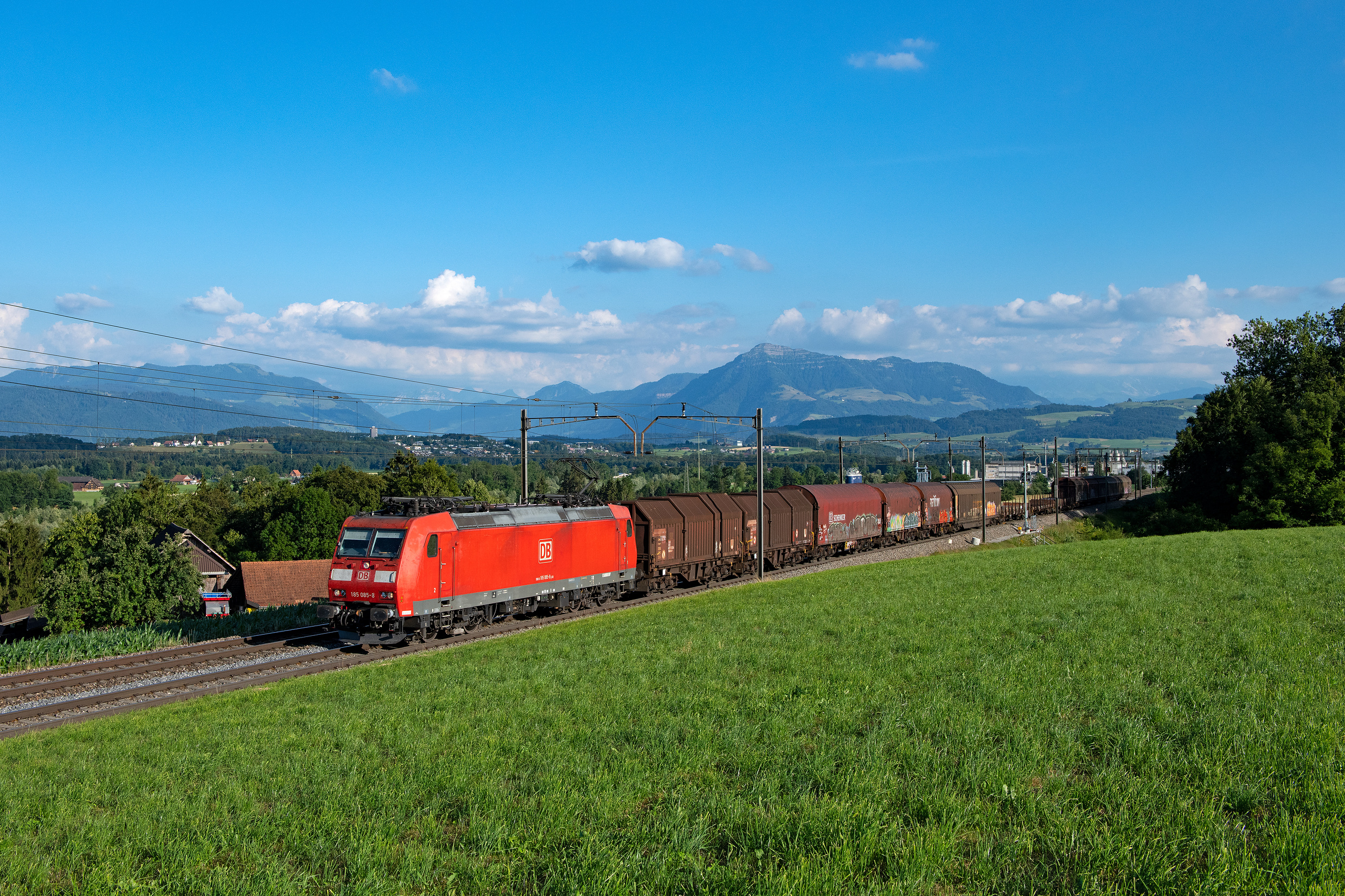
A DB Cargo Class 185 locomotive is pulling a steel train towards Basel near Sins. The photograph shows international rail freight transport on one of Europe’s most important north-south routes.
A flat railway through the Alps
The most visible result of this policy lies deep beneath the mountains. With the New Rail Link through the Alps (NEAT), Switzerland has fundamentally expanded its north-south connections. The base tunnels at Lötschberg, Gotthard and Ceneri form an efficient low-gradient railway through the Alps and bring the economic regions north and south of the Alps closer together.
The NEAT is not, however, purely a freight transport project. The base tunnels are also used by passenger trains. Switzerland therefore secures train paths for both types of traffic in the long term through its network utilisation concept and network utilisation plans. On the Basel–Gotthard–Chiasso route, for example, four freight train paths per hour in each direction are allocated for freight traffic. This is intended to prevent freight traffic from being displaced by further expansion of passenger services.
For freight transport, however, it is not just the additional capacity that is crucial. The gentler gradients enable heavier freight trains to be transported through the Alps more economically and increase the capacity of the north-south corridors. According to the FOT, up to 260 freight trains per day can run through the Gotthard Base Tunnel.
At 57 kilometres, the Gotthard Base Tunnel is the longest railway tunnel in the world. It was opened in 2016 and has been in operation since December of that year.
Did you know?
110 freight trainsUp to 110 freight trains can travel through the Lötschberg Base Tunnel every day.
Source: Federal Office of Transport
Four metres through the Alps
Swiss infrastructure is designed not only for crossing the Alps, but also to meet the requirements of combined transport. One example is the 4-metre corridor. Since 2020, semi-trailers with a corner height of four metres have been able to be transported by rail on the Gotthard axis. To this end, tunnels, platform canopies, signalling systems and traction power systems, amongst other things, have been adapted.
To ensure the corridor can be used without interruption, the Italian infrastructure has also been adapted. Switzerland has invested 120 million Swiss francs in the expansion of the Luino line. A further 148 million Swiss francs has been earmarked for expansion south of the Simplon. A total loan of 990 million Swiss francs is available for the 4-metre corridor. The transport chain must be designed to meet the requirements of freight transport across national borders.
Alongside SBB Cargo and BLS Cargo, DB Cargo Switzerland – the Swiss subsidiary of DB Cargo – is also active in the market and forms part of the European DB Cargo network.
Did you know?
24 billion Swiss francsAround 24 billion Swiss francs have been approved for the NEAT and the associated expansion measures.
Source: Federal Office of Transport
When the corridor stalls
Despite massive investment in infrastructure, rail is currently losing market share. By 2025, rail’s share of transalpine freight traffic had fallen from 70.3 to 68.6 per cent. The FOT attributes the decline, amongst other things, to construction works and the strained economic situation.
International feeder lines also remain a crucial factor. The Rhine Valley Line between Karlsruhe and Basel is the most important northern feeder line to the NEAT. Its upgrading has not yet been fully completed. Even the most modern infrastructure can only be effective if the neighbouring networks are also sufficiently capable.
What lessons can be learnt from Switzerland?
Due to its size, topography and unique transit location, Switzerland cannot be compared directly with Germany. Nevertheless, the Swiss system offers a number of insights that are also of interest to the German rail freight sector.
- Long-term infrastructure planning: The NEAT was developed over decades with a view to creating a key European north-south link.
- Guaranteed capacity: Freight transport is allocated train paths on the key north-south axes that are guaranteed in the long term.
- International corridors: The expansion of the Italian feeder lines demonstrates that infrastructure beyond a country’s own borders can also form part of a transport strategy.
- Political support: The modal shift mandate, the LSVA and infrastructure investments together form the political framework of the Swiss model.
For shippers, this means above all that the Swiss north-south axes combine high infrastructure standards with long-term guaranteed capacity for freight transport. At the same time, current developments show that even high-performance corridors remain dependent on construction works, the economic situation and neighbouring networks.
A system rather than a single project
It is not a single structure that makes Swiss rail freight transport special. Switzerland combines political objectives, targeted infrastructure investment and operational concepts to form a comprehensive system. What is decisive here is not so much a single project as the interplay of all the components.
At the same time, current developments show that even this model has its limits. Infrastructure creates opportunities, but does not guarantee a growing share of rail freight. The economic situation, construction works and the capacity of international feeder lines also influence rail freight transport. Perhaps this is precisely the most interesting insight from Switzerland:Rail freight transport does not follow a single, uniform formula.Geography, infrastructure, transport policy and operations together determine which solutions work.
And as soon as a freight train crosses the border, a national system becomes a European transport chain.
Additional information
- BAV: Modal shift of freight transport through the Alps
- BAV: Declining market share for rail in trans-Alpine freight transport
- BAV: The New Rail Link through the Alps (NEAT)
- BAV: Network utilisation concept and network utilisation plans
- BAV: 4-metre corridor
- BAV: Performance-based heavy goods vehicle charge (LSVA)
- BAV: Concept for freight transport
Note: No personal data is collected when submitting feedback. Feedback is processed anonymously. DB Cargo Privacy Notice
 Go
Go